Residential driveway repairs, sudden storm clearings near Eno River State Park, and late-running framing jobs in Old West Durham require reliable illumination long after dusk. A trailer-mounted vertical mast mast unit…
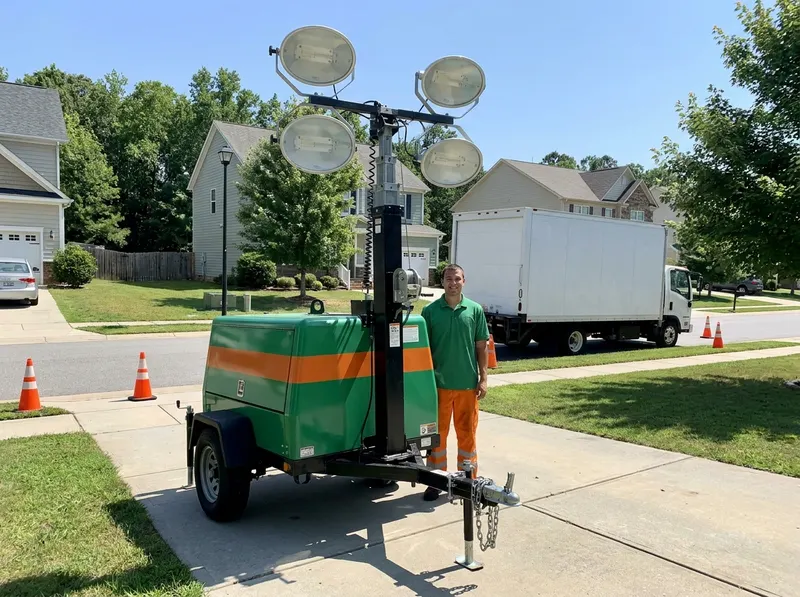
Residential driveway repairs, sudden storm clearings near Eno River State Park, and late-running framing jobs in Old West Durham require reliable illumination long after dusk. A trailer-mounted vertical mast mast unit fits tight residential footprints that traditional mast-arm floodlights cannot navigate. These light towers run self-contained liquid-cooled diesel engines, keeping 4,000 watts of light running for up to 60 to 70 hours on a single 30-gallon fuel tank without drawing from the home power panel. For tight urban driveways in Trinity Park or Duke Park, rotating masts swivel 359 degrees so crews can direct lighting onto gutters or rooflines without dragging equipment across landscaping. Placing outrigger footings directly on concrete or hot summer asphalt leaves severe indentation marks unless structural wood blocking spreads the ground load. Standard setup includes dedicated cribbing boards placed under each trailer outrigger to protect concrete and asphalt finishes from mechanical stress.
Selecting lighting hardware requires balancing light output against noise thresholds and neighborhood surroundings. Metal halide systems throw broader diffused light across open properties in Gorman or commercial perimeters near the American Tobacco Campus, while modern LED towers provide instant illumination without a 15-minute ballast warm-up cycle and use 60% less diesel fuel. In dense residential streets like Forest Hills or Woodcroft, an LED unit reduces engine sound to roughly 63 to 68 decibels at 23 feet, keeping municipal noise compliance intact for late-evening work. If a contractor is pouring an outdoor foundation slab, choosing high-efficiency LED heads keeps the lighting focused across the working perimeter without leaking glare directly into neighboring bedroom windows. For long-term projects in Brightleaf at the Park or Southpoint, multi-week deployments drop daily operating rates significantly compared to standard daily minimums.
Every towable tower is inspected for fluid levels, winch cable tension, and trailer brake functionality before drop-off. Step one is mapping site access through the driveway approach to ensure a 2-inch hitch ball setup or pintle ring has sufficient clearance past street parking. Step two involves deploying all four structural stabilizing outriggers on protective distribution pads before the vertical mast extends upward via hand winch or hydraulic switch. Step three requires confirming fuel reserves and verifying circuit breaker positions before cold-cranking the low-emission diesel power unit. The trade-off between diesel fuel delivery and on-site operation lies in maintenance runtime: units running continuous 12-hour shifts require oil checks every 100 operating hours. This reliable self-contained design bypasses the hazard of high-amperage extension cords trailing across walkways, keeping your job site safe, compliant, and thoroughly illuminated.
Every job gets a firm, written price after a free on-site visit.
Tell us about your towable light towers job in Durham and we'll send a clear, written quote, usually the same day.
 Timber Hill Dumpster Rental